
DG Progress: Dawn of the 28th Regime
An early look at the 28th Regime, the Transatlantic Talent Show, and an interview with an MEP who’s all in on EU-INC


We have stickers to celebrate hitting 100 followers, come and get yours! This is Kay & Patrick, with the second edition of DG Progress, the #1 pro-Europe, pro-tech, pro-meme newsletter in Brussels. In this edition we focus on the capital pouring into European tech, the fight over the EU’s AI rules, and an in-depth interview with MEP Damian Boeselager on startup policy. Spoiler alert …
… The time has come for the 28th Regime.
The EU is proposing a harmonised layer of corporate laws, above the 27 that apply within member states, to help companies set up and scale across the bloc. The European Commission is due to publish its proposal on Wednesday, setting off the negotiation process between the European Parliament and the EU’s member states.
A leaked version of the proposal indicates the Commission will opt for a Regulation rather than a Directive, which is an important step towards true harmonisation. We spoke with Damian Boeselager about why he’s been supporting EU-INC, the grassroots campaign advocating for this initiative.
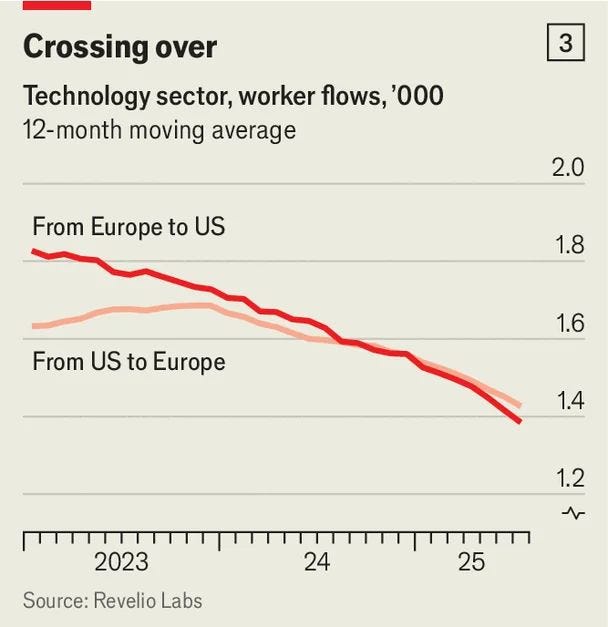
Meanwhile, Europe should celebrate that it now attracts more tech workers from the US than vice versa (see below), but the real story is that transatlantic talent flows are narrowing for both sides. In the last month, we gained AI pioneer Yan LeCun, but we lost breakthrough agentic AI developer Peter Steinberger. Though we retain an edge, the competition for talent remains in the balance.
🏗️ Making Progress
🇪🇺 Silicon Canals? Capital for AI startups is pouring into Europe, and is set to smash 2025’s record. In the last month alone, Swedish legaltech firm Legora raised half a billion euros, French frontier AI developer AMI Labs raised over a billion euros (Europe’s largest ever seed round), British autonomous driving leader Wayve raised €1.5 billion (backed by Mercedes-Benz), and British AI infrastructure hyperscaler Nscale raised €2 billion (Europe’s largest ever Series C)
🇫🇷 🇧🇪 🇮🇹 Startup pipelines. In a textbook case of virtuous investment flows when companies can scale, French champion Mistral AI acquired cloud start-up Koyeb. Elsewhere, Italian tech firm Bending Spoons launched a €1.5 million fellowship fund for the brightest computer scientists at universities across the EU and UK. And in the heart of Europe, WAT, Brussels’ first tech incubator, gets its first funding round in the AI space.
🇪🇺 More Companies are Female-Founded than Ever Before… which is still a tragically-low 13% of the total, according to the new Female Innovation Index 2026. Europe can do better.
🇫🇷 🇩🇪 AI robotics are a “once-in-a-generation opportunity” for Europe, given its “incredibly strong” industrial base, according to NVIDIA chief Jensen Huang. Right on cue, BMW deployed humanoid robots in one of its European factories for the first time, Montpellier-based health robotics company Quantum Surgical acquired an American subsidiary of Johnson & Johnson, and Metzingen-based Neura Robots gained unicorn status after raising €1 billion.
🇫🇷 🇫🇮 Quantum leaps. French quantum startup Pasqal went public at a €2 billion valuation. Just a few days after, Finnish quantum computing company IQM Quantum Computers has reached a €1.6bn pre-money valuation. Europe is proving to be a leader in gaining funding for deep tech.
🇬🇧 🇩🇪 🇺🇦 Lift off for European defence tech. Anglo-German defence start-up Hypersonica successfully tested Europe’s first hypersonic missile (capable of travelling in the inner atmosphere several times faster than the speed of sound). Meanwhile, the Pentagon is eyeing Ukrainian drones to fend off Iranian drone attacks. How’s that for sovereignty?

⛽ Policy Pitstop
AI Act under fire from EU tech leaders. In their annual community letter, Stripe co-founders from Ireland, Patrick and John Collison, labelled the regulation “a well-intentioned yet counterproductive burden,” while DeepL CEO Jaroslaw Kutylowski warned the bill is a “competitiveness disadvantage when it comes to attracting talent and new companies to Germany and the EU.”
“If you don’t embrace change and innovation, you will fall behind, and in Europe’s case, this means falling even further behind. So please, let’s finally start having a more positive and open mindset and embrace change and opportunities.” – Eric Demuth, President of Austria’s Bitpanda.
“I am working to make the AI Act more practical,” says Renew MEP Svenja Hahn, who’s helping draft suggestions to simplify the bill, which could include excluding non-consumer B2B uses of AI, clearer rules for data processing, and realistic enforcement timelines (something we’ve written about here).
Making cookie banners more practical as well? The European Commission’s Omnibus plan to eliminate cookie banners could use some improvement, we’ve written here.
European interests in mind. The EU’s top civil servant for digital policy, Roberto Viola, pushed back against critics claiming the simplification agenda is a design of Big US firms (echoing our analysis last month). This theory is “factually incorrect,” he said, “The truth is that there are hundreds of start-ups that have serious problems in applying and knowing how to apply the GDPR in the context of AI.” We’ve written about how the EU should reform its data law here.
Compliancemaxxing is the issue Europe faces, according to Belgian Prime Minister Bart De Wever, quoting research that shows “twice as many people in the EU work on implementing and monitoring rules as those working on innovative research.”
Expert advice: join EU-INC. A government-commissioned expert group “strongly recommends” that the German government join the EU-INC party. If not all EU member states can agree to a Regulation, the experts recommend Germany should join the “enhanced cooperation” mechanism for keen countries; if that fails, they propose a Franco-German agreement to which other countries are later free to join.
🌉 The Bridge
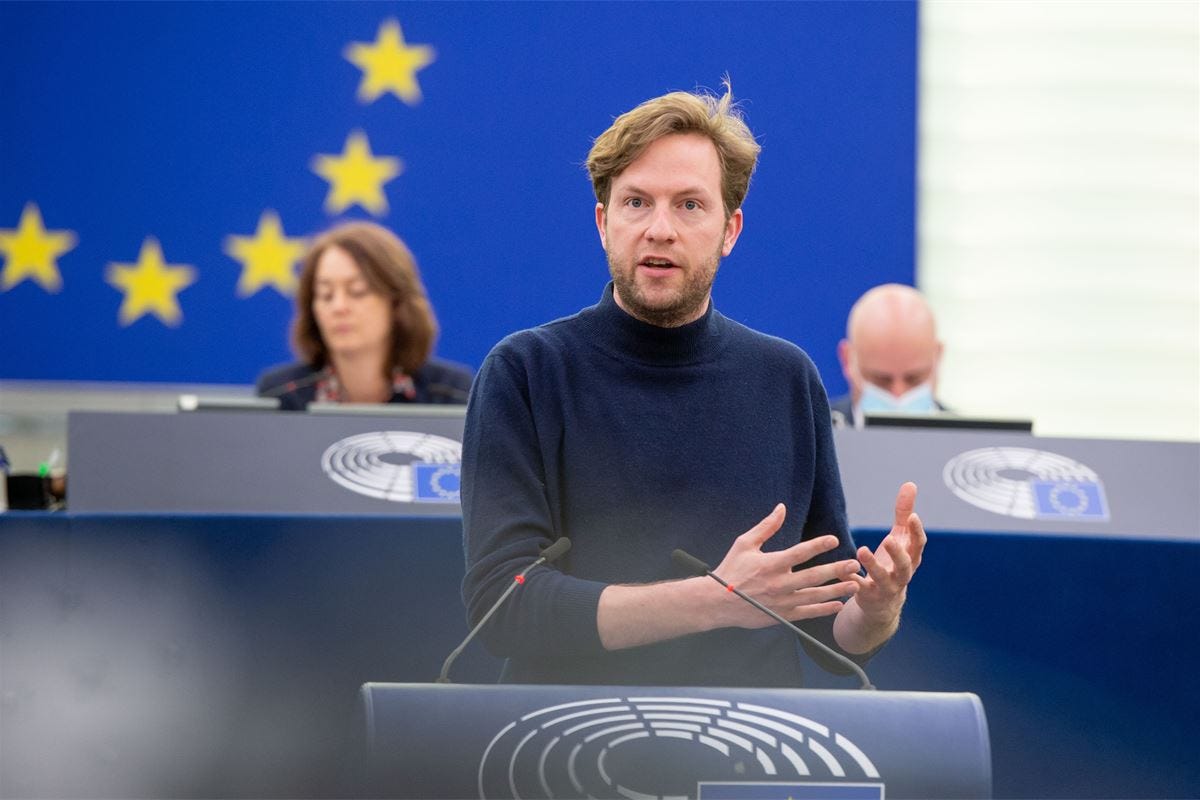
You are one of the strongest supporters of EU-INC. What has captured you personally or politically about this movement?
Competitiveness is our [the EU’s] core priority, but when it comes to the internal market, we have done nothing. Why is EU-INC cool? Because it helps investors understand corporate forms in Europe more easily. That’s one of the largest benefits because you know your voting rights and shareholder rights when you invest, especially if you don’t have to travel to that country for that investment to sign in front of a notary. … It was very clear to me that I would support EU-INC as much as possible.
You’ve been touring Europe, meeting founders from Helsinki, Paris, Berlin, Amsterdam and other European hubs. What lessons are you bringing back to policymakers here in Brussels?
What I heard from European founders and what I saw from founders in the US is that what’s important is the ease of opening the business, having a standard corporate form, being able to operate in European countries, hire people across the continent, and give them shares without complexity.
One of the things that I heard most is, “Okay, so when does [EU-INC] work? When can I get it?” When I say, “in three years”, it is because we have one year of negotiations and then two years of implementing a Directive; they have already lost interest. There’s a feeling of ‘you’re not hearing us’.
The 28th Regime proposal is due on the 18th. How can founders and investors continue to support this initiative?
I hear all the voices loudly, but I don’t hear a very loud institutionalised voice from VCs and startups. We must use the European network of startups and scale-ups to create pressure points at the right moments in time, and we can help by explaining when these pressure points exist and what is being discussed and negotiated.
However long the process is, if it’s one month or three years or longer, we need to make sure that we keep the pressure up. Because, in the end, the Commission President really put a lot of political capital into this one word (EU-INC). It’s time we hold her accountable to her promise.
🛣️ Road Ahead
18 March – The long-awaited 28th Regime is set to be published on Wednesday.
18 March – European Parliament committees are set to vote on their position for plans to simplify AI rules (its “AI Omnibus”), with negotiations with EU member states set for April. We provided our thoughts on this initiative here.
16 – 26 March – the next round of stakeholder workshops discussing the AI Act’s Transparency Code of Practice will take place. We wrote about our concerns with the process we observed in the first round here.
April – the EU’s new Scaleup Europe Fund, the largest funding instrument ever deployed at the EU level, will select a fund manager in April, with a summer launch planned.