
DG Progress: Robot Revolution
Europe’s robot revolution, AI Act negotiations, and Atomico’s Tom Wehmeier


Hello! This is Kay & Patrick, with the fourth edition of DG Progress, your source for European tech optimism. We are fresh back from the EU Startups Summit. Personal highlight: all the conversations with founders and entrepreneurs, looking to build and grow in Europe. There’s a lot to be excited about!
It’s no secret that one of Europe’s strengths on the global stage is its manufacturing sector. The continent’s industrialists continue to churn out world-beating cars, chemicals, aircraft—and now, robots!
The march towards automated factories goes on. But, Europe’s industrial leaders said in a recent joint letter (detailed below), only if the EU doesn’t hold them back with overlapping laws. Policymakers agreed this month to exempt parts of the AI Act—a good start.
This month we spoke with Tom Wehmeier of Atomico, which publishes annual State of European Tech reports, about the trends he’s observed in the innovation ecosystem, what’s holding startups back, and how to bridge the gap between what founders need and what policymakers in the EU are doing.
🏗️ Making Progress
🇩🇪🇨🇭🇫🇷🇬🇧 European robots on the move. Stuttgart-based startup Sereact raised €95 million to expand its robotics software business, introducing a new AI model and expanding to the US. Swiss Hexagon Robotics announced plans to deploy 1,000 robots on factory floors over the next 7 years. Meanwhile, Paris-based SquareMind raised €15 million to grow its full-body robotic scanning tool, and London’s All3 raised €25 million to bring its robotic construction platform to market.
🇪🇸 Striking a chord. Amadeus, a travel tech company, bought France-based IDEMIA Public Security (IPS) for €1.2 billion. The acquisition will allow Amadeus to offer a full biometric solution that covers customers’ entire journey, from booking to boarding and into government border management systems.
🇧🇪 Energie Ommekeer. The Belgian government is buying back all of Engie’s dormant nuclear power plants, putting them back to work to boost the country’s energy resilience.
🇩🇪 Leading the post-LLM world. German software giant SAP scooped up minnow compatriot Prior Labs, just 15 months after it was founded, agreeing to invest €1 billion in the next 4 years. Prior Labs’ AI model is built to use enterprise data from spreadsheets and databases (which LLMs don’t handle well). The acquisition provides a healthy exit for many European VCs.
🇱🇹 A helping second hand. Lithuania’s Vinted reached an €8 billion valuation thanks to an oversubscribed secondary share transaction of €880 million. In 2025, Vinted generated €1.1bn in annual revenue and €62 million in net profits, in 26 markets.
🇫🇮 Looking up. Finnish AI‑cloud provider Verda has raised €100 million to scale its European‑based AI‑hyperscaler infrastructure, hire over 100 people, and expand into new markets across Europe, the US, and Asia.
🇪🇺 Energy sovereignty. The European Investment Bank Group confirmed they will finance €2.4 billion for energy resilience and cutting-edge innovation, responding to geopolitical pressure, energy insecurity, and the EU’s need to compete in strategic tech.
⛽ Policy Pitstop
Tussle over the AI Act ends in compromise. Policymakers finalised negotiations to ease the impact of the AI Act on companies. Leaders agreed, with the help of some nudging from Germany, to exclude machinery (which is governed by sectoral laws). However, other sectors covered by their own liability laws, were not excluded.
EU Inc Parliamentarian announced: The European Parliament will kick off the EU Inc negotiations, and MEP René Repasi (who wrote a preemptive report – that could have been more ambitious! – last year) confirmed he will take the helm. Negotiations are due to conclude in 2026. You can let Repasi know that we need him to be more ambitious, by contacting his office here.
Wake-up call. A group of leading European industrialists from Airbus, ASML, Ericsson, Mistral AI, Nokia, SAP, and Siemens, called on the EU to urgently unify its markets, reduce overregulation, and invest strategically in AI and deep tech.
Competitiveness, actually. The Polish government published a non-paper urging the EU to reconsider its upcoming Digital Fitness Act, for the sake of competitiveness.
Scramble for AI. Hearing the buzz around Anthropic’s Mythos release, the EU’s AI Office wanted access, but will have to wait until August. European politicians are concerned that falling behind in access means missing cybersecurity vulnerabilities. OpenAI has since promised to hand over the keys to GPT-5.5-Cyber.
🌉 The Bridge

Tom Wehmeier is a Partner and Head of Intelligence at Atomico, a European venture capital firm. Atomico produces annual State of European Tech reports providing a comprehensive review of the ecosystem and the latest thinking of those who shape it.
Q1: There have now been 11 years of State of European Tech reports. What has changed in this time? Are there any trends you’ve seen?
Eleven years ago, a billion-dollar European tech company was exceptional. Today, we’re tracking a path toward trillion-dollar outcomes. That shift in the ceiling is reflected throughout the ecosystem — in the scale of entrepreneurial ambition, the calibre of talent willing to commit, the conviction of capital behind it.
The talent base has gone from hundreds of thousands to millions of people working in European tech, and it’s no longer a story about a handful of hubs but a genuinely pan-European phenomenon, with breakout success stories emerging from more than 100 cities and 30 countries. The volume matters, but the more important trend is what’s happening within the networks that have been built. Founders, operators, and investors are increasingly experienced, increasingly connected, and learning from each other faster than ever — and that compounds into the velocity, quality, and impact of decisions being made every day.
The flywheel is real: success breeds experience, experience breeds better companies, better companies breed bigger outcomes. Eleven years ago, we were reporting on Europe’s potential. Now we’re documenting compounding.
Q2: There’s a feeling in Europe that we have the talent, but our companies cannot scale. In your view, what are the biggest barriers preventing startups from becoming unicorns?
I’d start with the friction we still see in the system. Nearly 70% of founders say the regulatory environment is too restrictive. Europe must make it easier and faster to build, grow and sell across borders, at scale. One rulebook, one market, one standard. The upcoming EU-INC proposal is one important step in this direction, but the true prize remains delivering a true single market.
Then, capital. Europe is producing more global category leaders than ever, but too many face a structural funding gap at home. Late-stage rounds are smaller, scarcer and slower. Our strongest companies cannot have their ambitions capped by shallow capital pools. We need deep, liquid, full-stack markets from first cheque to IPO and beyond.
On talent, as mentioned above, the base is deep and expanding faster than the US, but the system still slows people down, and makes it harder to attract, reward and retain the world’s best talent. It remains harder to hire in, slower to relocate to, and more complex to move across than competing regions. Stock options, visas, taxation, and employment reform are all part of the picture here.
And finally, risk culture. Too often, risk is managed away rather than rewarded. Only 20% of European corporations actively engage with startups, versus 50% in the US. We need to treat risk culture as foundational infrastructure, as essential to our future as energy or capital.
Q3: What are the biggest gaps or misunderstandings between Brussels policymakers and Europe’s tech entrepreneurs? How can we help bridge them?
Fortunately, I see this gap as narrower than it’s ever been. There’s genuine alignment now on the problem statement — what’s required to make Europe the best place to start and scale entrepreneurial innovation. More policymakers get what needs fixing. The missions we talk about — Fix the Friction, Fund the Future, Empower Talent, Champion Risk — are all under active discussion at national and European levels. The political focus is there.
What matters now is design, delivery, and the will to act on the hard things. That’s where consistent ecosystem engagement becomes critical. If founders and operators are in the room through the design and delivery phase, you’re far more likely to end up with solutions people actually want and will use.
EU Inc shows what sustained, deep engagement can achieve — but also just how much energy and commitment it takes. That’s a replicable model. We need to apply it consistently across policy areas, not just one. To make that a success, it will require bold and ambitious policymaking, but also a tech community that is advocating publicly and helping make and win arguments.
🛣️ Road Ahead
End of May: Tech sovereignty package “including the Cloud and AI Development Act (CAIDA), the Chips Act 2, a strategy on open source, and a “strategic roadmap” for digitalisation and AI in energy.”
8 – 12 June: London Tech Week
17 - 19 June: DG Progress will be at the Beyond Expo in Athens!
15-18 June: EP Plenary vote on the EU’s AI Omnibus
Ongoing: negotiations over the EU’s Digital Omnibus package
🪟Window Seat
The best meme we’ve seen in the past month. Send us your favourites at dgprogress@progresschamber.org.
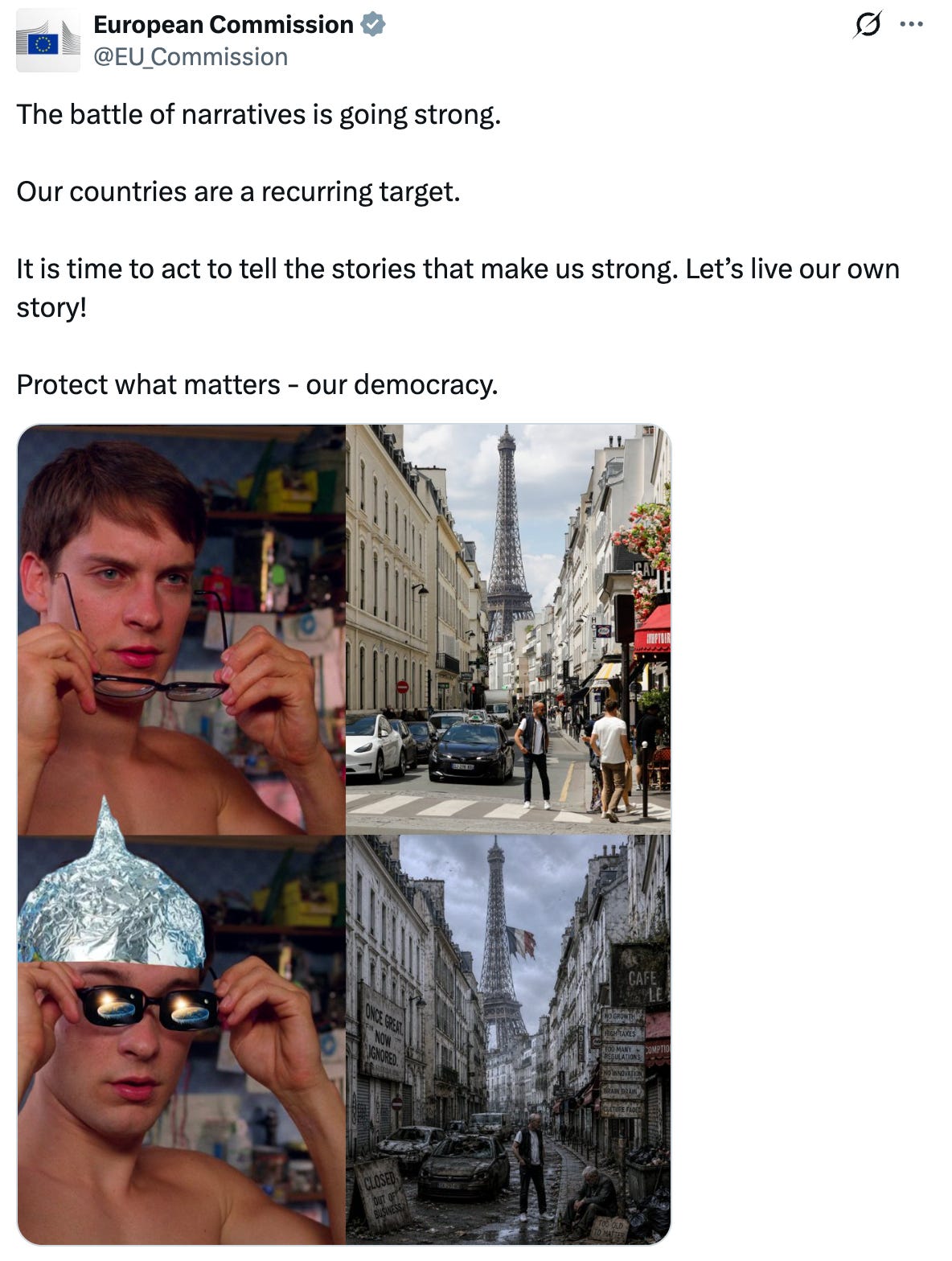
The EU’s executive taking a pop at those conspiring around the demise of Europe (a popular talking point among far-right voices who often – ironically! – reside outside the continent).