
DG Progress: Spring Season for European Tech
Investments across the AI supply chain, industrial policy galore, and our conversation with Benedict Evans


Hello! This is Kay & Patrick, with the third edition of DG Progress, your source for European tech optimism. We’ll be in Malta from 7–8 May for the EU Startups Summit. Drop us a line if you’re there, too ☕
We’re excited in this month’s The Bridge to share a discussion we had with Benedict Evans, a renowned global tech analyst, about the EU’s trials and tribulations in becoming a digital superpower. Can better regulation help end Europe’s tech winter?
One element of renewal could be the long-awaited 28th Regime proposal, whose rainy reviews we summarise below. Alternatively, the EU’s tech sovereignty package could improve conditions, yet it continues to face controversy. The debate over what sovereignty actually means and what would be the best version for Europe goes on, with the EU’s industrialists urging the bloc to remain focused on its strengths and open to international partnerships rather than succumb to protectionist pressures.
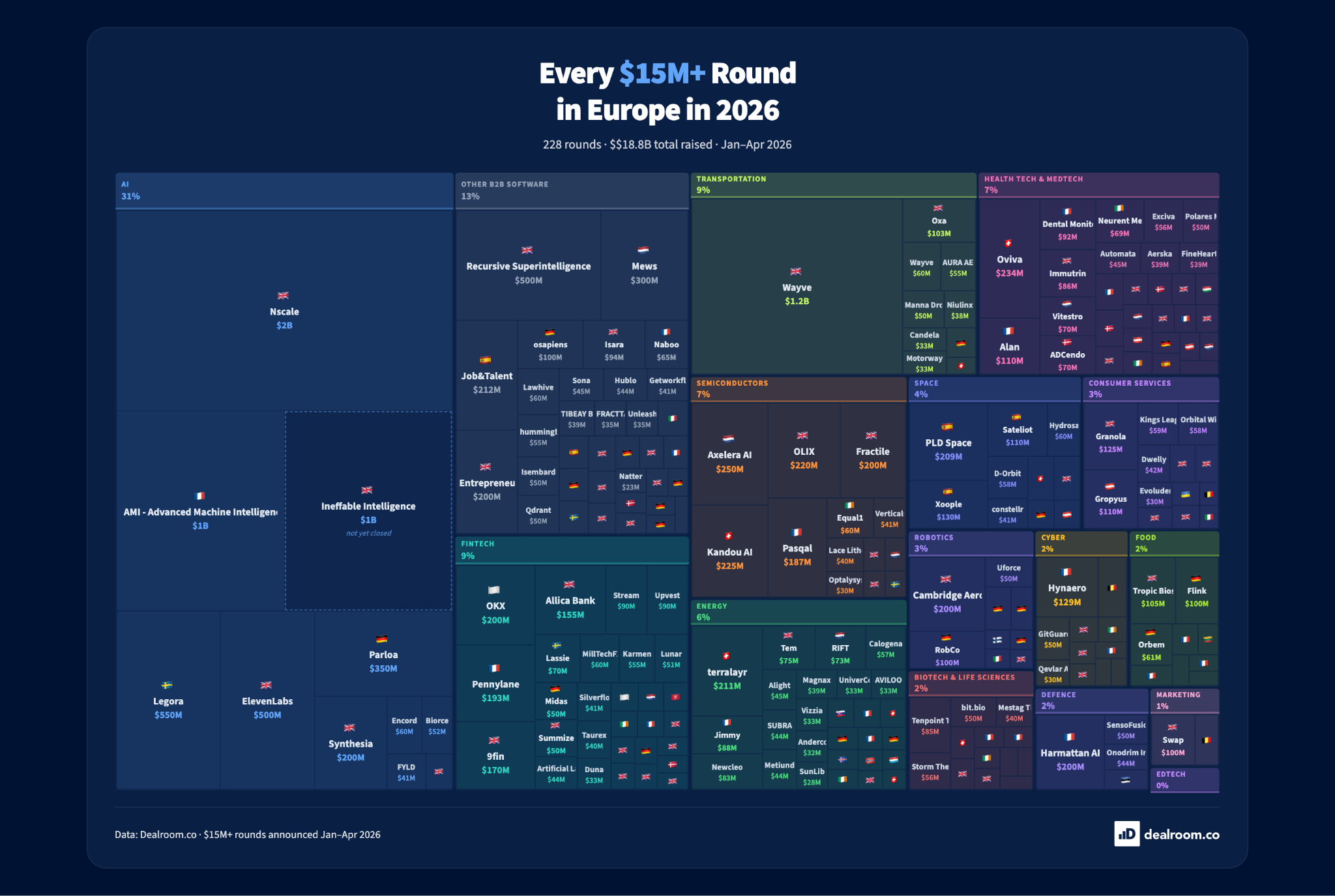
But despite the policy headwinds, there is some light, as investments across the AI stack continue to pour into Europe.
🏗️ Making Progress
🇫🇷 Leaders gonna lead. French darling Mistral AI raised over €700 billion to build a new data centre near Paris, and released a new text-to-speech model.
🇳🇱 Flywheel in action. ASML alumni are behind a new Dutch start-up that claims to be building GPUs 100x more efficient than those currently on the market and is raising €100 million. Elsewhere in the Dutch ecosystem, Agentic AI platform Wonderful hit a €1.7 billion valuation after a successful series B funding round.
🇩🇪 German connections. SPRIN–D, a DARPA-inspired agency founded in Leipzig, announced a new fund aiming to support three frontier AI labs. German AI leader Aleph Alpha is also rumoured to be merging with Canada’s Cohere, in a move that envisions dual headquarters.
🇮🇹 Leaning in. Pisa-based CamGraPhic secured €211 million to build AI infrastructure, a boost provided by the EU’s State Aid Framework – one of the largest single public investments ever made in an Italian DeepTech startup.
🇸🇪 My dear Watson. Stockholm’s Legora, a legal AI company, aims to go global with a new campaign fronted by Jude Law targeting cities across Europe and the US.
🇪🇪Front seat view. Bolt announced a deal with NVIDIA to build the software required for its plans to scale self-driving cars across Europe, from 2026.
🇫🇷 Lucy in the sky. Paris-based Quendela will soon unveil a new quantum computer, Lucy, that could be the most powerful available to European researchers and companies.
🇪🇺 European Union getting in on the action …
The European Investment Bank (EIB) Group announced it will significantly expand its European Tech Champions Initiative, pledging a further €15 billion to scale up innovative companies. It aims to mobilise €80 billion in private investments to close the funding gap European innovators face.
Separately, the EIB announced multi-million euro investments in health scale-ups BioLamina 🇸🇪 and Orion Pharma 🇫🇮.
Meanwhile, the European Commission confirmed it will invest over €1 billion in 57 defence projects (including AI and drones)
📉 … But needs help on product launches. The tool the EU is building to help its citizens verify their age online was immediately hacked and easily bypassed. Green MEP Markéta Gregorová described the process as “rushed under political pressure more than actual safety concerns.”
⛽ Policy Pitstop
The 28th Regime proposal (mostly) disappointed. The long-awaited 28th Regime drew praise 🙋for being a Regulation rather than a Directive, for including a quick (< 48hrs) and convenient (online) incorporation, and for its improved stock and exit mechanisms for investors and founders. However, the overall sentiment is that it needs to be more ambitious:
“The test was always simple: does it provide as much legal certainty as the Delaware Inc? If not, founders and investors will continue to use Delaware Inc as a global investment standard,” according to the early warning from EU-INC campaigners in response to a leaked draft.
“Credit where it’s due - this is an important step that shows real effort to simplify business across Europe … but falls short of being a true 28th regime said Allied For Startups, raising concerns on the lack of a single EU registry, and how insolvency and restructuring remain fragmented.
Scaling across Europe is still curbed by national barriers, argued MEP Damian Boeselager.
“We needed more,” lamented Lucien Burm, President of the Dutch Startup Association, as companies will still face legal uncertainty.
“Significant gaps remain,” said the Association for Competitive Technology, noting the tax, employee, investment, and registry rules that are left to national governments.
“The law contains so many referrals to national law that it is more complex than the national systems it was meant to avoid,” concluded Silicon Continent.
While applauding the pushback on notaries, and the political will it took, three academics writing for Oxford Business Law argue for more: “The ambition that animated Letta and Draghi — and that this Commission has the mandate to act on — deserves a vehicle equal to it. EU Inc. could be that vehicle. It is not there yet.”
Others pushed back against some of this criticism. Notably, the President of the European Innovation Council Board, Michiel Scheffer dismissed the idea that centralising the legal systems would be desirable or feasible in the short term. France Digital took a more nuanced view that, while the EU Inc. is “a pivotal step forward, complementary measures remain essential, pointing to the need for further action on public procurement reform the Savings and Investment Union.
Industrialists have come out against the EU’s upcoming tech sovereignty package (again delayed to the end of May), raising concerns that in the absence of international partnerships, European companies would be forced to rely on less optimal services.
We still don’t have all the details of what’s in the package, but it could be a “disaster”, says Siemens CEO Roland Busch, “you should not throttle your innovation speed for the sake of creating sovereignty”.
“Full sovereignty for any region worldwide is crazy, “ warned imec’s Chief Strategy Officer Jo De Boeck, “you need to have partnerships”.
“Welfare” for weak startups is how ex-Sequoia investor and Evantic founder Matt Miller described the idea, in an interview with Sifted.
“Being an entrepreneur is often misunderstood and complex,” says the head of a new campaign aimed at giving French entrepreneurs a seat at the political table. 40 well-known builders signed on, including leaders from Ledger, Too Good To Go, and Aircall. Good to see others tapping into some of that DG Progress energy!
Europe has the money, according to ECIPE’s Andrea Dugo, but it just doesn’t put it to work. Timely that the Commission is currently running a consultation on private equity exits to inform its Savings and Investment Union strategy.
🌉 The Bridge

Benedict Evans is one of the world’s most respected technology analysts, a seasoned venture partner, and author of a leading tech newsletter. We spoke to Benedict about the EU’s regulatory positioning, how laws impact product designs, and the importance of even AI adoption.
How is Brussels’ approach to regulation, especially in the digital space, viewed from potential investors and partners across the world?
When I talk to people in the Valley, there’s a perception that a lot of this is protectionism, which I don’t think anyone in Europe thinks it is.
The other thing is it’s such a big cultural conflict and an execution conflict. Americans are used to rules-based systems where you’re told what the rules are. They would come to Europe, and they thought the answer would be, “As long as you follow the principles, it’ll be fine.”
The problem is, if you’re Apple or Meta making changes to comply with new laws, you think this follows the principles, and you ask the EU for guidance and don’t get any feedback. Then they’d go home, wake up, and get an email that said, “Nope, you’re in breach, here’s a billion-dollar fine.” That gets a bunch of people in the Valley going to D.C., saying, “This is just bad faith. We tried to follow the rules.”
What do you make of the pushback that companies give when enforcers mandate specific design changes to their products because of a certain policy objective?
I wrote a piece a couple of years ago where I said that when you try to regulate any profession, they will always say no. I said you’ve just got to push in and say there are three kinds of “no.”
The first kind of “no” is, “We don’t want to, it’s a pain in the arse, it will cost us money, we don’t like that decision”—like putting seatbelts in the car. We think it’s dumb, maybe it isn’t dumb - whatever, we can do it if we have to.
The second kind of “no” is, “You’ve just asked us to give the Chinese access to all our internal data,” and you really didn’t realise that you were doing that. For cars, imagine you decide there could be a market for car engine replacement, so every car has to have one lever that you can pull that will disconnect the engine. You don’t really need to know anything about cars to know why that’s a really bad idea. You could do it, but again, a really, really bad idea with huge unintended consequences.
Then the third example is, “Yes, you need to make gasoline that doesn’t burn,” or “Please make secure encryption that the police can read. The problem is that the companies come back and say, “This is impossible, it will destroy our product, we can’t do it.”
Which is it? Which of those three “no’s” are they talking about? Is this WhatsApp saying, “No, we can’t give complete third-party interoperability?” Or is it people saying, “You have to scan everything for CSAM [child sexual abuse imagery], but also you’re not allowed to scan everything.”
Do you think that jurisdictions that fail to adopt or deploy AI are going to disadvantage themselves in the coming decades?
Yes. This is kind of true: if you stop deploying new technology, and this is the foundational new technology for the next 10 or 15 years, at a minimum. The base case is this is like cloud, or mobile, or open source, or PCs—it’s the new thing that everything in tech will get built around.
There’s an old joke that when the apocalypse comes, you want to be in France, because everything happens 10 years later there. You kind of see a layer of this in technology. If you look at the adoption data—everything from online advertising to e-commerce to business deployment of cloud, and now, how many people have used AI.
You’ve got the UK, the Nordics, and small northern countries like Benelux. In some cases, they had an adoption ahead of the USA. Then, France, Germany, Spain, and Italy are way behind. That applies across any metric you want to look at for technology adoption. That makes it tough to build a business on a pan-European scale.
🛣️ Road Ahead
27 April: European Commission consultation on private equity exits closes.
End of April: The EU is due to announce who will manage a new €5 billion tech fund.
April – June: Member States reviewing the 28th Regime proposal via Council Working Parties.
5 – 7 May: POLITICO’s AI & Tech Week 2026 (DG Progress will be there 🇧🇪)
7 – 8 May: EU Startups Summit 2026 (DG Progress will be there! 🇲🇹)
End of May: Tech sovereignty package “including the Cloud and AI Development Act (CAIDA), the Chips Act 2, a strategy on open source, and a “strategic roadmap” for digitalisation and AI in energy.”
8 – 12 June: London Tech Week (DG Progress will be there! 🇬🇧)
🪟Window Seat
A new section dedicated to the best meme we’ve seen in the past month. Send us your favourites at DGProgress@progresschamber.org.
April’s Meme of the Month courtesy of EU-INC’s Andreas Klinger, caught surfing on LinkedIn.