
Europe Revs Up Self-Driving Cars
Innovations on the road, joint industry pleas, and our interview with MEP Markéta Gregorová


Hello! This is Kay & Patrick, with the fourth edition of DG Progress, your #1 source for optimism about European tech.
🥂 We’re hosting our first in-person get-together in Brussels next Wednesday at 18.00. Sign up here, and join us if you can! We’ll be celebrating 400 followers (fingers crossed) and the start of European summer!
This edition looks at the quick progress being made to put self-driving cars on European roads, and the big investments Big EuroTech are making in Europe. Europe’s tech industry, both big and small, continues to urge the EU to simplify its rulebook and remain open to international trade.
We also spoke with Markéta Gregorová, an MEP representing the Czech Pirate Party, about the EU’s competitiveness agenda, its botched age verification app, and the EU’s access to frontier AI models.
🏗️ Making Progress
2026 will be the year of self-driving cars in Europe. Croats have been ordering robotaxis in Zagreb since April. This month, Wayve and Uber have opened a waitlist for Londoners who should enjoy rides in 2026. Madrid, meanwhile, confirmed it will open their roads to self-driving cars by the end of the year.
Right on time, Chamber of Progress released a study which lays bare the opportunity for Europe: by 2035, in the report’s “optimistic scenario”, automated ridehailing could add up to €9 billion to the EU’s economy, reduce emissions by 900 million kg c02, and prevent up to 6,875 traffic collisions annually. We’ve just called on policymakers to get driverless cars on European roads.
Elsewhere in Europe, the Big EuroTech flywheel continues to spin. When companies are allowed to scale, they soon attract investment and talent from abroad, and reinvest it at home:
🇫🇷🇩🇪🇦🇹 Helping Hanz. Mistral, France’s AI Champion, acquired Austrian physics AI startup Emmi AI, while German software giant SAP struck a deal to boost N8n.
🇫🇷🇩🇪 Brothers-in-arms. Airbus and BMW meanwhile partnered with Mistral to integrate advanced intelligence into defence and automotive safety systems.
🇩🇪 Absolute cinema. German startup Black Forest Labs cast legendary Hollywood director Martin Scorsese as a partner at the company to help shape their visual AI tool.
🇩🇪🇪🇸🇫🇷 FDIs-approved. German drone maker Helsing saw its valuation balloon over $18 billion after investments from US investors. Barcelona-based AI business Factorial raised €129m, becoming a unicorn, after funding from US firm General Catalyst, while Finland’s ICEYE shot to unicorn status after funding from New York-based General Atlantic. Foreign investors pledged €93bn at Macron’s Choose France summit, with significant capital earmarked for scaling AI infrastructure.
🇬🇧 All together now. Balderton Capital launched the Built In Europe initiative, which is another living example of the surge in Euro-positivism and the belief in a brighter European future. The campaign serves as a compass for creators to find accelerators and incubators, and bridges the gap for top talent looking for exciting roles at growing startups.
⛽ Policy Pitstop
European innovators, big and small, are working together to urge the EU to help them scale, compete, and continue to attract investment and customers from abroad. Meanwhile, the EU is asking for feedback on its all-important EU-Inc proposal.
EU’ve got mail.
“European Tech Creators”, a group of Big EuroTech comprising Airbus, ASML, Ericsson, Mistral, Nokia, SAP, and Siemens, called on the European Commission to “urgently shift from merely regulating technology to creating it… we urge leaders to replace red tape with innovation-friendly guardrails.”
Meanwhile, a group of 30 of Europe’s most prominent EU founders, including from Lovable, Bolt, NestAI, Kry, and Voi, wrote an open letter urging the EU to get its Digital Omnibus (simplification of data laws) right. “We are asking lawmakers to show the same boldness European founders show every day.”
According to a leaked note, the D9+ (the EU’s digital frontrunner member states), to maintain strategic partnerships, enact simplification-by-design when making new laws, and continue to search for ways to simplify the digital rulebook.
AI diplomacy.
The EU published its Tech Sovereignty Package, initiatives intended to boost the bloc’s digital capabilities, resilience to external threats, and industrial sector (we warned the package might handicap European startups by limiting the investment pool and increasing their input costs)
European Commission President Von der Leyen appointed Siemens’ chairman Jim Hagemann Snabe as the bloc’s “Special Envoy for Industrial AI”.
The EU is set to join US-led Pax Silica, an initiative that aims to curb China’s influence in the tech sector, particularly within AI supply chains.
Christoph Fouquet, boss of Europe’s largest company, ASML, warned against overemphasising local production in the AI supply chain, saying that “no country will ever have it all” and later urged Europe to first Build European instead of Buy European – ”you have got to have something to buy from”.
Meanwhile, EU courts are mulling over whether to overturn global copyright law, in what is billed as the first major AI training case involving a Hungarian news outlet and Google. A new study by Implement Consulting Group argues that Europe could miss out on €600 billion if frontier models and European AI applications can’t access large, diverse datasets.
In better news, the European Parliament signed off on measures to simplify and delay the AI Act’s implementation.
EU Inc consultation and under fire
The European Commission opened a public consultation on its 28th Regime (“EU Inc”) proposal, which closes 25 June.
EU Member States are worried about the legal implications of this ambitious proposal to create an EU-wide company registration (bold action is never free!)
BMW’s boss urged policymakers to improve the framework – ”Right intention, wrong design”
Stockholm cure. The European Commission selected Stockholm-based EQT to lead its €5 billion startup fund. The fund will back ambitious startups in sectors such as AI, robotics, semiconductors, energy, biotech, and space.
🌉 The Bridge
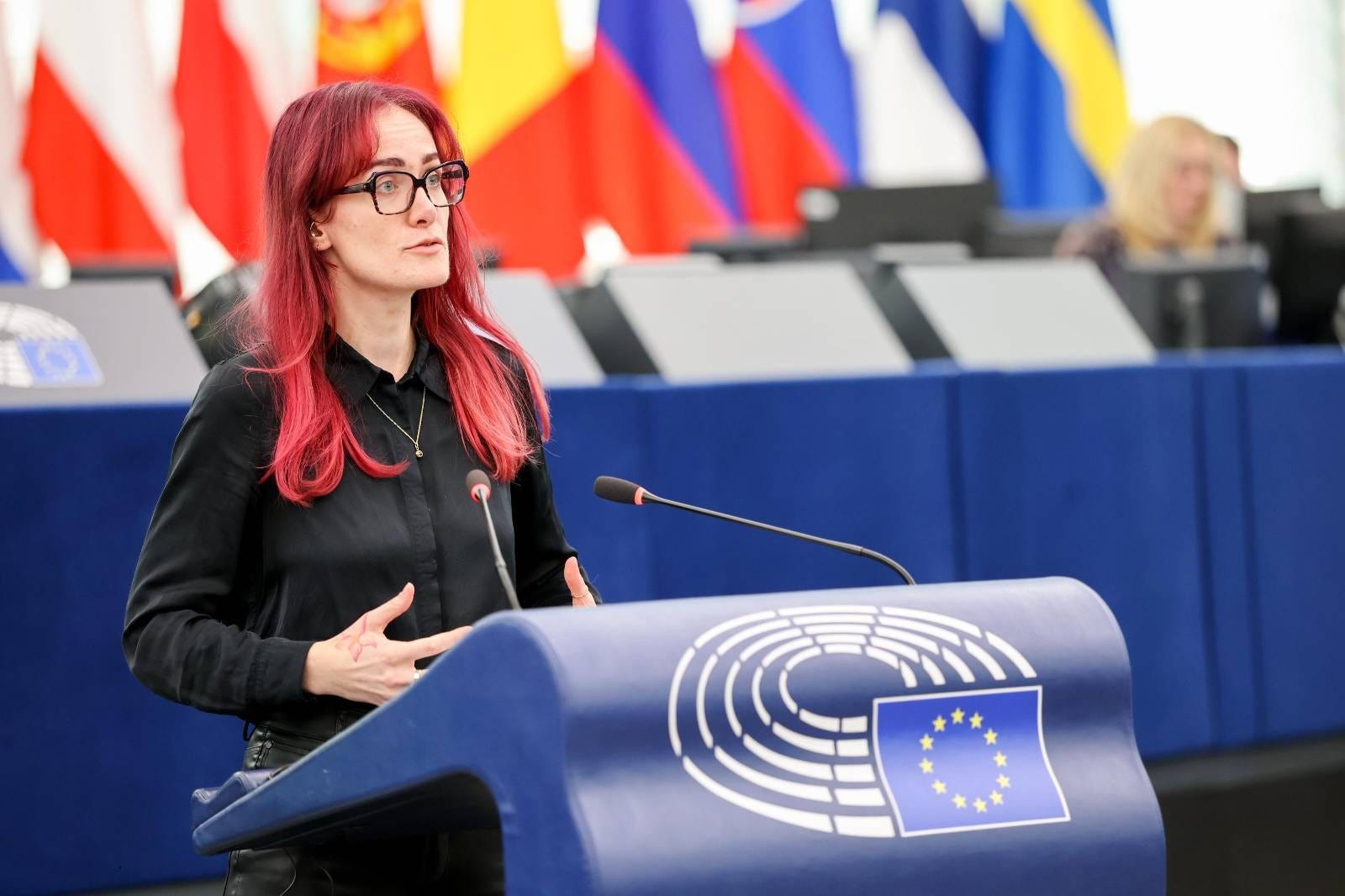
Markéta Gregorová is a Czech Member of the European Parliament, representing the Czech Pirate Party. Gregorová is a member of the Committee on International Trade and the Special Committee on Foreign Interference in all Democratic Processes in the European Union.
This Commission’s focus is on competitiveness and simplification. Do you think this is a long-term shift in focus, a crisis response, or something else?
“Europe is under pressure from several sides at once: economic competition from the US and China, high energy prices, security threats, and concerns that European rules are becoming too complex. So the Commission is trying to show that Europe can still innovate and stay economically strong.
The problem is that “simplification” can sometimes become an excuse for weakening important protections, whether on privacy, consumer rights, or the environment. The challenge is finding a balance: making rules easier to understand and apply, without removing the safeguards that people actually depend on.”
The EU’s age verification app arrived flawed and was immediately hacked, something you’ve suggested was a symptom of a rushed process under political pressure. At the same time, Commission President Von der Leyen said a proposal for an EU-wide social media ban could arrive as soon as this summer. What’s your perspective?
“Protecting children online is important, but rushed technological solutions can create new risks instead of solving existing ones. The age verification app showed exactly that. Experts warned from the beginning that the system could create privacy and security problems, and the early flaws confirmed those concerns.
I’m also worried that the debate is becoming too focused on surveillance and identity checks instead of addressing the real problems of online platforms: addictive algorithms, harmful recommendation systems, or weak protections for minors. A broad social media ban for young people sounds politically simple, but in practice, it raises many difficult questions about privacy, enforcement, and effectiveness. Policymakers should be careful not to sacrifice digital rights in the name of quick political answers.”
The focus of AI policy has turned toward cybersecurity, and the importance of having access to the latest models. How do you think policymakers can better avoid the unintended consequences of well-meaning legislation?
“On the crucial topic of agentic LLMs being able to outpace human cyber security researchers by finding difficult and minor zero day vulnerabilities and then stringing them together into an exploitable chain, we are entering an unprecedented legislative terrain. Our core task as legislators is to highlight this fundamental shift in cybersecurity publicly and secondly to pass legislation that ensures that our critical systems are updated and patched using the same technology for defensive purposes.
Critical for us lawmakers is to ensure that the EU has access to the newest frontier models, access to enough compute and equally to enough energy to train and run these models. Unintended consequences would weaken Europe in all these areas.”
🛣️ Road Ahead
23 June: DG Progress drinks 🍻 (come join us!)
25 June: Deadline for the European Commission’s consultation on the 28th Regime (EU Inc)
23 July: Deadline for the European Commission’s consultation on AI Act High Risk Guidelines (thanks for the Commission for extending the submission deadline)
Ongoing: negotiations over the EU’s Digital Omnibus package
🪟Window Seat
The best meme we’ve seen in the past month. Send us your favourites at dgprogress@progresschamber.org.
EU Comms teams continue to earn their money.
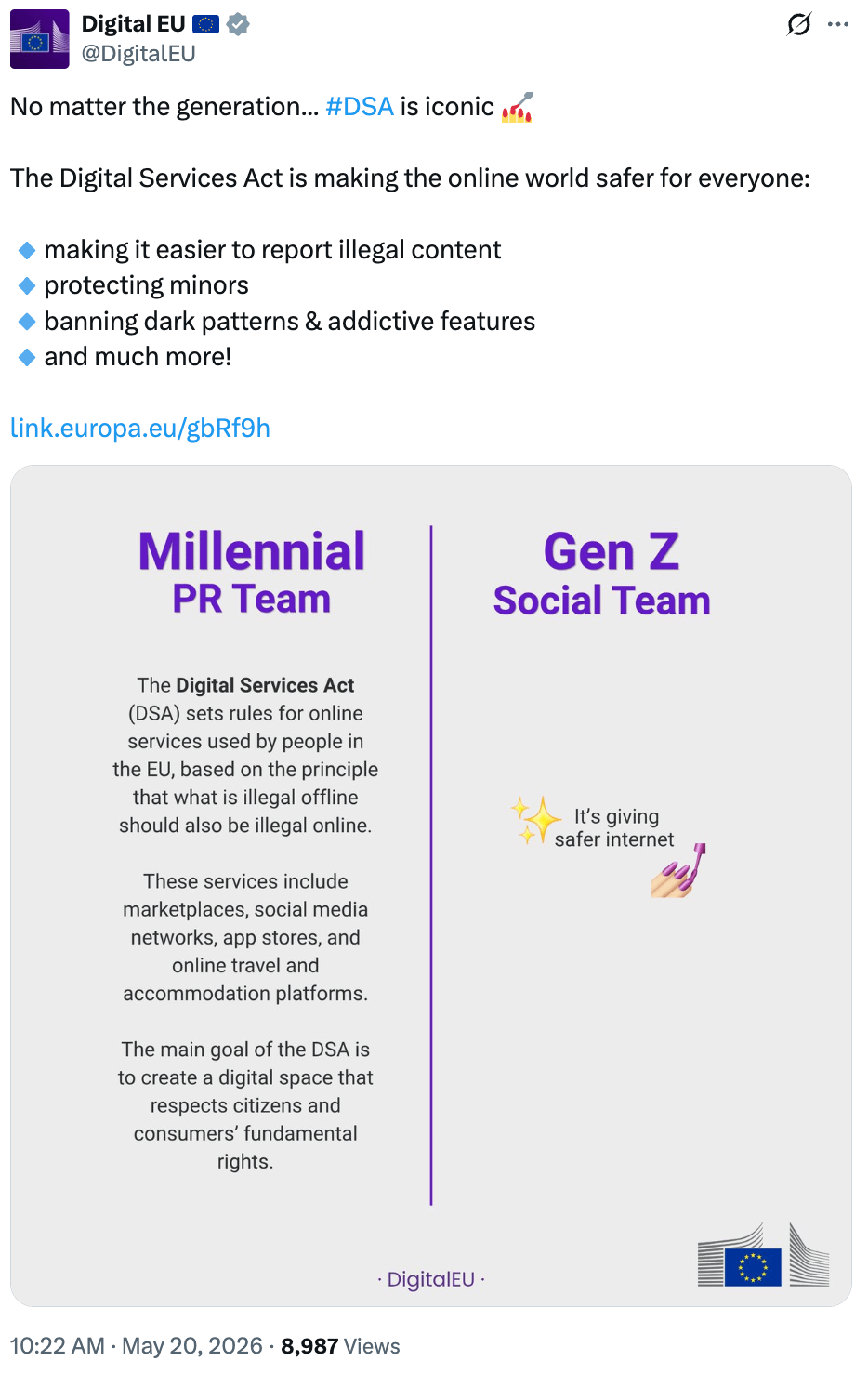
… no need for a social media ban, then?